+34 934 356 489
  bcn@avisualstudios.es

chroma
Everything you need to know about shooting on Chroma

Are you thinking about shooting your next project on a Chroma set but it’s your first time? In today’s article, we’ll tell you everything you need to know about shooting on Chroma to make your next shoot a complete success. ?
Chroma Key is an audiovisual technique that involves extracting a color from an image or video to replace it with another using an editing program. Many people think that to create a good chroma, you need to know a lot about post-production, but on the contrary, you need more knowledge about lighting and camera work than After Effects.
Lighting is everything
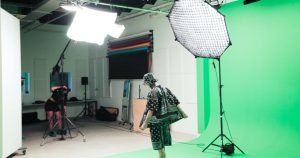
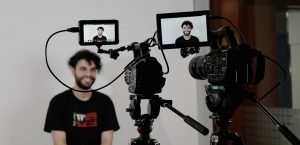
This is the most complex part. To start, it’s important to know that you first light the Chroma and then the subject(s) so that the background is as clean and homogeneous as possible. If this condition is not met, the post-production work will be much longer and tedious, or even impossible to cut out. To ensure it’s well-lit, we can use a light meter or an Atomos Shogun recorder monitor.
The recommended lighting is LED type with diffusers so that the light received is soft and doesn’t create shadows. For lighting the subjects, the illumination should be in accordance with the desired final effect.
The space

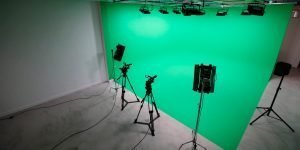
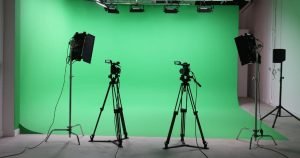
Although portable backgrounds exist today, the safe bet is a professional Chroma studio. With it, you ensure there’s enough space and distance between the background, subjects, and technical equipment. With portable or more “homemade” backgrounds, the space is very limited and you’ll have to be very careful that the background is well-tensioned and doesn’t have a single wrinkle. This is a factor you’ll surely encounter because these backgrounds are usually folded.
Lighting is much more controllable as the studios have the necessary background lighting already pre-established. Additionally, being indoors, factors such as natural light, shadows, wind… don’t influence.
The camera
Make sure you have a camera with very little compression and that works in RAW to be able to obtain good results in the post-production phase.
It’s also advisable to take into account the color temperature, so that it’s adjusted to the temperature of the lights you use. Likewise, you shouldn’t use filters during filming, this is something that should be retouched in the post-production phase.
Green or blue?

Although blue is the traditional color in more classic cinema, and is still used in many productions today, green is the preferred color for digital recording, but why?
- Most digital cameras use a Bayer pattern of red, green, and blue (RGB) filters, in which the number of green filters is double that of red and blue. This makes digital cameras much more sensitive to green coloration.
- The green chroma requires much less lighting than the blue screen, which absorbs luminosity.
- It’s less likely that the chroma green will match your actors’ or subjects’ clothing, as it’s not a “natural” color.
Definitely, unless you’re going to film a big green monster, it’s better to use a green chroma.
You should also know that the subjects or elements appearing in the scene should not wear clothes of the same tone or color, nor reflective or shiny elements such as glasses, jewelry, bottles…
If you ultimately want the peace of mind and control that a perfectly conditioned Chroma studio provides, come visit us at Avisual Studios.
If you liked the article, tag us and share it on your social networks! ?